
Buyer's Don't Set the Price
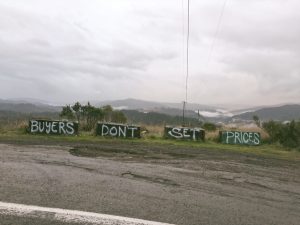
Conversations around prices per pound have always been a topic of discussion within the world of weed. Years ago a pound could easily sell for $5,700, which is how many people and communities thrived. Some of us grew a little, some of us grew lots; but all of us were able to sustain our lives and families for a product produced in Humboldt that is notoriously known worldwide for being the place on the planet that grows the best weed. The Emerald Triangle encompasses Mendocino, Humboldt, and Trinity Counties, but I’ll dare to say that Southern Humboldt is the “soul center of sungrown” and also the region where Doug Fir did the 1979 drop. The best weed was and is still grown in this green triangle and I’ll stand firm once again that the Humboldt County environment (now categorically and capitalistically called “terrior”) is the reason why. The Mediterranean climate boosts hot days and cool nights, with the coastal influences circulating two air exchanges a day. Pair that with supreme genetics and growers that learned (and continue to learn) the trade year after year, decade after decade, and you have weed that is traditionally trademarked as being the best. I’m certainly biased. My husband has been growing weed for over three decades and he knows his land and genetics inside and out. I’m sure lots of men and women can attest to the same.
When it was time to sell weed in the traditional market (before legalization), the price was set by the grower, not the buyer. Sure, there were slight negotiations, but we named the price and we got it. Every once in a while, a local would sell their pounds way below what we all kept to, and word spread like wildfire and they were known as a “sellout.” It didn’t matter much in SoHum; this community has always been forgiving and tolerant, but man oh man, that mishap and or calculated choice made in need or greed forever left its mark on the man.
Legalization has us looking long and hard on prices again. And on sellouts. We all scrambled during the arduous process; hurdle after hurdle, fee after fee, inspection after inspection, every single one of us did what we could to keep afloat. Some people scaled back, sold pieces of property we loved (Craig and I had to do that), and some people sold their weed for prices that went below not only what they were actually worth, but also below their moral and ethical standards. Hey, to each their own right? Or is it? If everything we do individually clearly affects the whole, what exactly did those lower priced pounds set into motion for the community and the cannabis world alike?
I always tell Craig Humboldt weed could have been branded, but there were too many band members and too many men who wanted to be the lead singer. If we all would have come together, ensured every pound was stamped with the Humboldt trademark, and set and kept the price, I feel more of the community would have made it. But the egos and the very real differences in growing and curing would set the pounds and the people apart. And who would run it? Oversee it? Meet with brokers? It all seemed to be too much and even now, it is.
Everyone has their reason to sell for less, some very real ones too; aphids, land payments, taxes, production cost, not good at the legal business side of it. Most farmers were content behind the gate, and those not interested in marketing, branding and networking did what they had to do to stay alive. I can’t judge it. But I believe, (or should I say I would like to believe) that the real reason behind the selling out is Gavin Newsom’s fractured supply chain that was baked into the cannabis regulations. Modeled after the alcohol industry, Newsom’s rules made certain there were no consequences to the distributors, manufacturers, and retailers; they were immune to any liabilities that might arise from the purchasing of our sun grown weed. What this means is farmers were forced to front their product to the supply chain with only promises of payment, many which did not come. Craig has always said there is “no future in fronting,” but what if you have no choice? Back in the day, you brought your weed to the buyer’s house, who would sit and smoke a joint from each strain, decide what and how much they wanted. The weed train was from farmer (who was also the seller) to buyer. Rarely did you front, but if you did and you didn’t get paid, everyone knew. Now the weed train is farmer, transportation, distribution/manufacturing, testing, transportation (again), dispensary, consumer. Every touch point has a cost. And if something goes wrong (prices drop, weed is ruined in transport, etc), the product itself can never go back to the farmer. It is stuck in the system, invisible to the person who actually produced and owns it, and who is simply told the new price is what the new price is. If there is even a price at that point. This fractured supply chain is how the “first mile” distribution was born. How many dudes are on the couch now?
There are still plenty of women and men hustling for their worth and the worth of this plant, and I am thankful for them and the hard work they continue to do for themselves and their community. When I hear jarred eighths going for as low as $6 dollars, and many selling in the $9-10 dollar range, I lose my breath and then my cool. It is outrageous that anyone could sell for that low, and more outrageous someone would suggest they do. And it seems the same people who are the most vocal at crying the blues about the price are doing so while also crying community. Some people have other very real and solid forms of income that pay the bills (or investment money), so selling their side hustle of weed for a price that undercuts and undermines their community may not affect them at all. But it does affect the rest of us. Imagine if you would, heading out to the farmers market and selling your eggs, veggies, cheese, wine, or beef at a fraction of the cost the farmers next to you have set their price at for years. Might give some people a stomach ache. A talking point for sure.
I know this month’s blog may be a bit spicy and sound a bit salty, though please know that’s not my intention. I will always respect people’s right to make decisions about their lives and well being that is best for them and their families. But this is my life I’m talking about. And I too have the right to speak about things that impact me, my family, and my community. I am grateful to have worked alongside my husband for decades producing great weed. I am grateful to have had the strength and the bandwidth to keep up with the pounding waves of change that came with cannabis regulation. I am grateful that I had a beloved piece of property I had no choice but to sell that financially enabled us to move though the fees that accompanied compliance. I am grateful that Craig and I stayed in our lane (and our marriage), reached out for support, and had the courage to cultivate new relationships, both business and personal. And I am deeply grateful to our business partners who continue to pay all their farmers a living wage. There are good people in this world, and good people in the world of weed. Let’s all be one of them.